

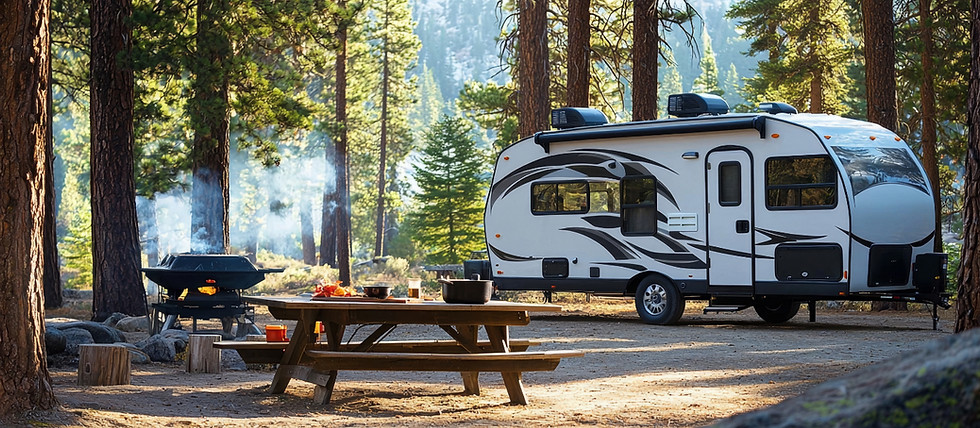

Recreational Vehicle Insurance
Just like the automotive sector, recreational vehicles traveling on the road are subject to Quebec’s Automobile Insurance Act. The minimum liability coverage a vehicle owner must carry is $50,000 for bodily injury and property damage caused to others.
Travel trailers and motorhomes can move freely throughout North America. It is essential to stay well informed about the scope of your coverage if you travel outside Quebec. In other parts of Canada and the United States, the right to pursue a claim against the at-fault party is always possible.In the United States, you may be exposed to significant lawsuits, as claims are based on your personal assets and your liability at the time of the accident. Additionally, most insurers require you to notify them if you plan to travel to the United States for more than thirty days, as premium surcharges may apply. A specialized insurer, however, already factors North American travel into its pricing for RV owners, so no surcharge will be applied within a six-month period.
In Mexico and even in Europe, it is possible to extend the territorial limits of your policy to include these countries by adding an endorsement (FAQ no. 44) for an additional premium. Certain coverages can also be purchased at the Mexican border through local market representatives. However, caution is advised, as insurance policies offered at the border may come from insurers whose financial stability is not entirely certain.
Through your insurance broker, it is possible to obtain adequate coverage from Quebec. Exclusive arrangements with a wholesaler for insurance products in Mexico are planned to help you avoid unpleasant surprises.
If you own a recreational vehicle (RV), your broker can offer you a policy tailored to your vehicle type and your travel plans.
Civil Liability
The location where your RV is used influences the amount of coverage you should carry. An accident in Florida represents a higher risk than a stationary RV in Quebec. It is recommended to have at least one million dollars in liability coverage, and even more if you travel abroad. Some specialized insurers offer up to $2,000,000 for travelers and $1,000,000 for stationary models.
Vehicle Damage
The actual value of the vehicle determines the amount of insurance required. Even for a lower-value vehicle, it is important to insure it against damage (collision, theft, vandalism), especially outside Quebec. Coverage can also extend to storage.
The home insurance policy
Some RVs, like travel trailers, can be added to your home insurance policy, but the coverage is sometimes limited, especially for belongings that are kept outside your main residence. It’s important to make sure that the items inside your RV are properly covered.
Specialized insurance
A specialized policy is often the most suitable option, as it considers the specific characteristics of your RV, including its type, usage, age, and maintenance. It provides all necessary coverage at an affordable price, whether your vehicle is in use or stationary.
Specialized Insurance for Recreational Vehicles
Certains avenants peuvent être ajoutés à votre contrat pour améliorer votre protection, selon le type de véhicule et l’usage que vous en faites.
Replacement Cost Coverage (FAQ 43d)
In the event of a partial loss, repairs are carried out using new parts. In the case of a total loss, you may receive a settlement based on the purchase price, without taking depreciation into account. This coverage is generally offered for RVs less than 10 to 20 years old, depending on the type.
Outdoor Property
Equipment such as decks, awnings, outbuildings, fixed accessories, and other outdoor items can be insured separately. Some specialized policies also cover personal belongings, often at their replacement value, without affecting your home insurance.
Borrowed or Rented Vehicle (FAQ 27)
If you rent a recreational vehicle for a short term, this coverage protects you for damages up to $50,000 and eliminates the need to purchase the rental company’s insurance.
Loss of Use (FAQ 20a)
This coverage allows you to receive reimbursement for renting a replacement vehicle or for transportation costs during the period your RV is unusable due to a covered loss.
Living Expenses
If a loss occurs far from home, emergency lodging, meals, and transportation expenses may be reimbursed.
Personal Insurance (FAQ 34)
In the event of an accident involving your recreational vehicle, you may receive a benefit in the case of death or to cover certain medical expenses, regardless of your liability.
In the event of an accident involving your recreational vehicle, you may receive a benefit in the case of death or to cover certain medical expenses, regardless of your liability.
Some policies offer options to reduce or waive your deductible in specific situations, such as a collision outside Quebec with an uninsured driver, or in the event of a hit-and-run.
Roadside Assistance
Some policies offer options to reduce or waive your deductible in specific situations, such as a collision outside Quebec with an uninsured driver, or in the event of a hit-and-run.
In Case of an Accident
If you notice that someone is injured or that the damage appears significant, call 911. Afterwards, if possible, obtain the police report number.
At the scene of the accident, exchange basic information with the other drivers involved. The accident report form is the ideal tool.
Try to write down the names of any witnesses.
Never accept money or admit responsibility for the accident.Dans tous les cas de sinistres
If your vehicle has been stolen in its entirety or if you are the victim of a hit-and-run, contact 911 immediately and obtain a police report.
Contact us as soon as possible to report the claim. We will inform you of the steps to follow, promptly forward your indemnity request to your insurer, and ensure that your claim is processed quickly and fairly.
We will also assess whether you are eligible for a rental vehicle if your car cannot be driven.
If we are unavailable, you may contact your insurer directly by calling their 24/7 emergency claims number. This number is usually found on your pink slip. However, please make sure to contact us as soon as possible so we can follow up on your file with your insurer.-
Being a member of an association such as the Fédération Québécoise de Camping et de Caravaning (FQCC) or having completed a driving course offered by the FQCC. For details, please visit: http://www.fqcc.ca/.
-
Your RV is a stationary or park model and is located on a campsite belonging to a Camping Québec member. For details, visit: http://www.campingquebec.com/.
-
Having a device that prevents the vehicle from starting or a tracking system.
-
Choosing a higher deductible.
-
My careful and responsible driving helps maintain a good driving record and keeps my auto insurance premium affordable.
I avoid driving the vehicle after consuming alcohol.
I obey speed limits, traffic signs, and stay focused on the road.
I maintain a safe distance between my vehicle and the one in front of me.Tips to Prevent Theft or Vandalism
-
Always close and lock your car doors and windows when parked, and if possible, park in a well-lit area on a busy street.
-
Do not leave valuables in the vehicle where they are visible to passersby.
-
Ensure the vehicle’s alarm system is functional.
-
Never leave a child alone in the vehicle.
-
Never leave a vehicle running and unattended, even for a few seconds.
While traveling, certain precautions can help ensure your safety:
-
Always make sure you have enough fuel for your planned trip.
-
Check the condition of your tires and use ones suitable for the season.
-
Keep a survival kit in the vehicle.
-
Listen to local radio for weather updates.
-
Make sure to take regular rest breaks.
What a survival kit may contain:
-
Basic first aid supplies.
-
A blanket, gloves, a hat, and chocolate bars.
-
A flashlight, flares, and jumper cables.
-
In winter, include a shovel and a bag of sand or salt in the vehicle.
-
A strong rope, a flag, or a piece of red cloth.
-